2
Disposable foam plugs
far cheaper★★☆☆☆ 2.3
- Minimal price per pair and available everywhere
- Our eight-year-olds could not roll and insert them properly
- Useless once wet, and in the trash after one use
A child’s ear is not a scaled-down adult ear: the canal is shorter and narrower, so most adult-sized plugs either will not go in or will not seal. We tested twelve pairs with children aged four to twelve, at the pool and at home. Here is the order.
See our #1 ›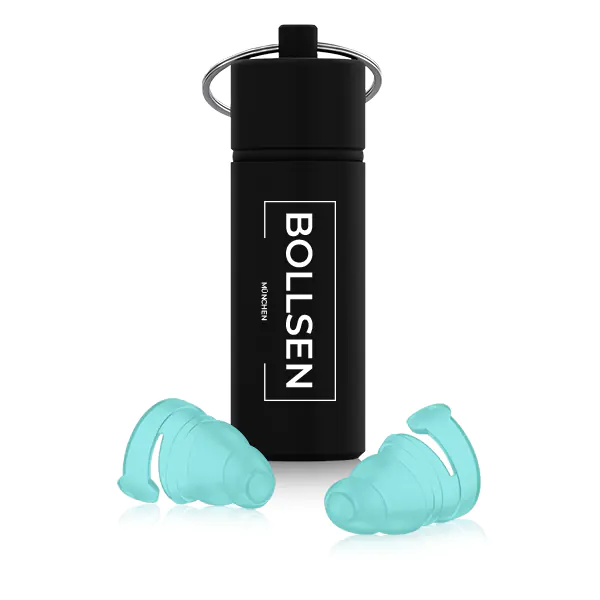
The only pair six-year-olds put in unaided, and the only one that also sealed in the pool. Nothing to roll, no small parts, and the color is why you can find them in a swim bag.
✓ Sold by BOLLSEN · free shipping over $39 · 40-day returns
A child will not tell you the plug is not sealing. They just take it out when nobody is looking.
Seven of the twelve pairs were adult models in a small package, and in a six-year-old’s ear they either slid in too far or barely went in at all. Not one of the children said so — we found out because they kept taking them off.
So we scored whether the child can put them in, sealing in water and whether you can find them. Attenuation was a requirement here too, not a criterion.
Our test starts at four, because below that the size of the ear canal and the swallowing risk stop this being a product question. For babies and toddlers, ear muffs that cover the ear are the usual answer. If something is wrong with a child’s ear, a pediatrician decides — a product test does not answer that.
If your child has ear tubes, whether they should wear plugs in water is a decision for their doctor, not for a review site. Guidance on this has changed over the years and it depends on the individual child, so ask the person who put them in.
Six-year-olds put them in themselves. With most of the field that did not work.
See our #1 ›Over ten weeks — a weekly swim lesson, bath time, one flight and two birthday parties — the BOLLSEN Kidz+ were the only pair the children did not take out on their own.
A good kids’ plug is one the child can fit. The one that needs a parent gets left at home twice a week.
No rolling and no two-handed work: push it into place and it is done. Our eight-year-olds could not insert foam properly, and badly inserted foam is worth exactly nothing.
Two flanges sit one behind the other inside the canal. At swim lessons the testing children never once reported feeling water — with the adult-sized models that happened four times.
An aluminum case is included and it stays shut in a wet bag. It sounds like a detail, but three quarters of the caseless pairs in the test disappeared in the first month.
Ten weeks of swim lessons and bath times. The same pair.
See our #1 ›The only pair six-year-olds inserted unaided, and that sealed in the pool throughout.
| Rated on | Kidz+ | Foam | Wax | Adult silicone | Ear muffs |
|---|---|---|---|---|---|
| Child can fit them alone | ✓ | ✗ | ~ | ~ | ✓ |
| Seal in water | ✓ | ✗ | ~ | ~ | ✗ |
| Findable in the bag | ✓ | ✗ | ✗ | ~ | ✓ |
✓ meets · ~ partly · ✗ does not meet — based on the pros and cons in the cards above; tap a card to open it.
See our #1 ›We bought twelve pairs at retail and used them for ten weeks with children aged four to twelve: a weekly swim lesson, bath time at home, one flight and two birthday parties. We logged who could fit them unaided and when they took them out. Not one pair came from a manufacturer.
The winner is made from the same medical-grade silicone as the adult models, but with a body dimensioned for a child’s ear canal. It is a passive plug with no electronics: it quiets sound and keeps water out. Results vary from child to child, because ear size does.