2
Disposable foam plugs
far cheaper★★★☆☆ 3.2
- Highest stated attenuation in the test, for pennies
- Rolling and inserting them in a dark club is a lottery
- In the trash after one night
A concert earplug is not decided by how much it blocks. It is decided by whether you leave it in after the second song. We wore fifteen pairs through club nights, a three-day festival and rehearsal rooms. Here is the order.
See our #1 ›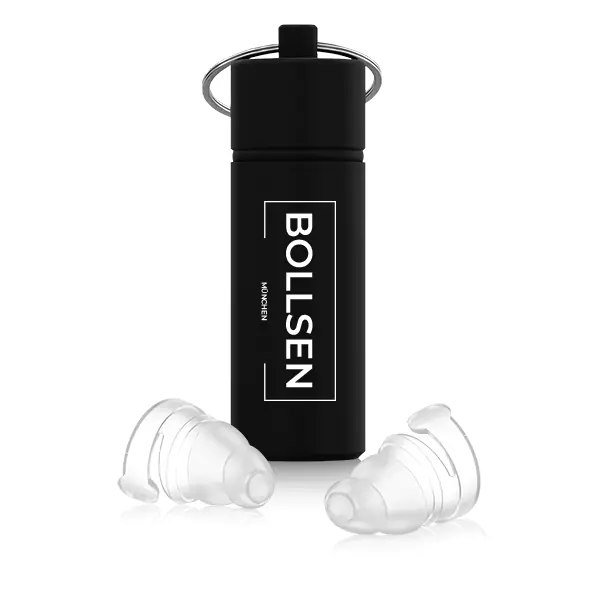
The only pair our testers kept in through a four-hour festival set. Nothing protrudes, so nothing catches in a crowd, and the keyring case is why they still had them the next morning.
✓ Sold by BOLLSEN · free shipping over $39 · 40-day returns
A passive earplug makes music quieter. It does not leave the sound untouched, and anyone promising that is overstating it.
These plugs take most off the high end and least off the low. In front of the stage that means the kick drum stays and the edge comes off the cymbals. Plenty of people prefer it that way, but let us call it what it is: this is not the original mix at a lower volume.
So our three criteria were comfort after four hours, staying put in a crowd and still having them in the morning. Attenuation was a requirement: a model without a measured figure did not enter the ranking.
Earplugs sold in the US usually carry an NRR figure, set by the EPA. BOLLSEN publishes a European EN 352-2 measurement instead — 24 dB, measured by an independent German laboratory. The two numbers are produced by different test methods and are not interchangeable, so we quote the figure that was actually measured rather than converting it into something it is not.
You hear everything more quietly, conversation included. The plug does not lift one sound above another. Most testers still found it easier to follow a conversation in a club — because the background dropped too, not because a filter passed speech through.
Still in at hour four. The rest of the field was in a pocket by then.
See our #1 ›Across three club nights, a three-day festival and eight rehearsals, the BOLLSEN Music SoundPRO were the only pair testers left in from start to finish.
The best concert plug is not the one that sounds prettiest. It is the one still in your ear in the fourth hour.
In a crowd a protruding stem meets a shoulder, a jacket collar, your own hand. We lost three pairs in the test exactly that way. There is nothing here to catch.
A club night is not ninety minutes. Testers took the tight, hard-bodied models out after the second hour, and from then on they blocked nothing at all. This pair was the only one that lasted the longest set.
Aluminum case on a keyring. It sounds trivial and it decided the test: half the pairs without a case were gone after the first weekend.
A festival, three club nights, eight rehearsals. The same pair.
See our #1 ›The only pair still comfortable after four hours, and the only one a tester did not lose in a crowd.
| Rated on | Music SoundPRO | Foam | Alpine | Loop | Custom molds |
|---|---|---|---|---|---|
| Comfortable after 4 hours | ✓ | ✗ | ~ | ~ | ✓ |
| Do not catch in a crowd | ✓ | ✓ | ✗ | ✗ | ✓ |
| Still there in the morning | ✓ | ✗ | ~ | ~ | ✓ |
✓ meets · ~ partly · ✗ does not meet — based on the pros and cons in the cards above; tap a card to open it.
See our #1 ›We bought fifteen pairs at retail and wore them over ten weeks: three club nights, a three-day festival and eight band rehearsals. We logged when they came out and whether they were there for the next occasion. None came from a manufacturer.
The winner’s attenuation was measured by an independent German laboratory to EN 352-2: 24 dB overall, of which 24 dB at high tones, 21 dB at mid and 19 dB at low. It takes most off the high end — it quiets, it does not separate sounds. There is no electronics in it.