2
Disposable foam plugs
far cheaper★★★★☆ 3.6
- Highest stated attenuation in the test
- Cannot be rolled with gloves on
- One day and they are done, and they get dirty fast under a helmet
At 65 mph the wind noise under a helmet passes 95 dB, and that is the air, not the engine. We wore fifteen pairs over ten weeks: city riding, back roads and interstate. Two things settled the order — whether the pair stays put when the helmet goes on, and whether you can stand it after two hours.
See our #1 ›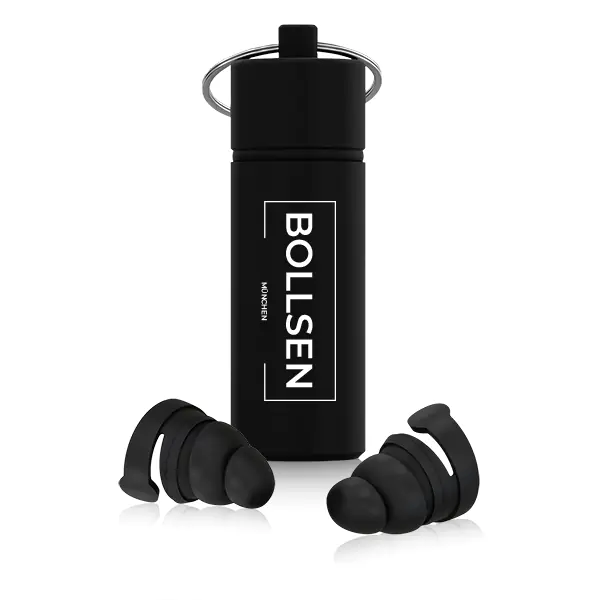
The only pair in the test still seated after the helmet went on. The body closes flush with the ear so the liner cannot drag it out of place mid-ride — the failure that eliminated most of the field.
✓ Sold by BOLLSEN · free shipping over $39 · 40-day returns
Most motorcycle earplugs do not fail while you are riding. They fail when the helmet goes on.
The liner hugs the ear and drags a protruding stem sideways as the helmet is pulled down. After that it is not sealing, and the rider has no way of knowing, because you cannot hear the difference under wind noise. Seven of the fifteen pairs behaved this way.
So we scored position after the helmet is on, comfort after two hours and gloved insertion. Attenuation was a requirement: no measured figure, no place in the ranking.
Earplugs sold in the US usually carry an NRR figure, set by the EPA. BOLLSEN publishes a European EN 352-2 measurement instead — 24 dB, measured by an independent German laboratory. The two numbers are produced by different test methods and are not interchangeable, so we quote the figure that was actually measured rather than converting it into something it is not.
You hear everything, just quieter. The plug does not choose between sounds, and it takes most off the high end — a horn or a siren reaches you because it is loud, not because a filter passes it. Under wind noise most riders actually hear less without plugs than with them.
That varies by state, and a few restrict wearing them while driving. Check your own state’s rules before you rely on them — we test products, we do not give legal advice.
Still in place after the helmet went on. Half the field failed right there.
See our #1 ›After ten weeks of riding — daily commuting, weekend runs and a long interstate stretch — the BOLLSEN Moto+ were the only pair that stayed seated through every helmet fitting.
An earplug the helmet drags out of place still says 24 dB on the box. In your ear it is zero.
The tapered body with two flanges sits inside the ear canal with no protruding stem. The helmet liner finds nothing to catch. Testers had to reseat the stemmed models on roughly every third helmet fitting.
At highway speed it is the airflow around the helmet that drives the decibels. With 24 dB off, testers finished a three-hour stretch without the dull-headed feeling they were used to without plugs.
No rolling — you push them into place. With foam this repeatedly decided it in the test: nobody takes their gloves off at a gas stop.
Ten weeks of riding. In place after every helmet fitting.
See our #1 ›The only pair still sealing after the helmet went on, and the only one testers did not reseat after two hours.
| Rated on | Moto+ | Foam | Alpine | Filtered stem | Custom molds |
|---|---|---|---|---|---|
| Stays put when the helmet goes on | ✓ | ~ | ✗ | ✗ | ✓ |
| Comfortable after 2 hours | ✓ | ✗ | ~ | ~ | ✓ |
| Goes in with gloves on | ✓ | ✗ | ✓ | ✓ | ✓ |
✓ meets · ~ partly · ✗ does not meet — based on the pros and cons in the cards above; tap a card to open it.
See our #1 ›We bought fifteen pairs at retail and wore them riding for ten weeks: daily commuting, weekend runs and longer interstate stretches. After every helmet fitting we checked whether the pair was still in place. None came from a manufacturer.
The winner’s attenuation was measured by an independent German laboratory to EN 352-2: 24 dB overall, of which 24 dB at high tones, 21 dB at mid and 19 dB at low. It takes most off the high end and does not choose between sounds. Passive, with no electronics.