2
Disposable foam plugs
far cheaper★★★★☆ 3.7
- High stated attenuation and a minimal price per pair
- Have to be rolled before insertion, which is awkward on board
- In the trash after one flight
Cabin noise at cruise runs around 80 dB and it goes on for hours. That is what leaves you flattened on landing if you stayed awake the whole way. We took twenty pairs onto twelve flights, from a short hop to a ten-hour route with a connection. The order came down to which pair was still in at landing.
See our #1 ›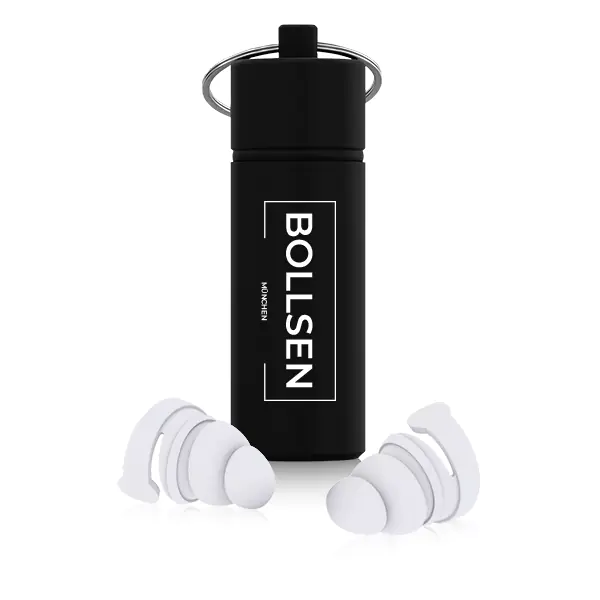
Two things matter on a plane: staying comfortable for hours, and not pressing when your head is against the headrest. This was the only pair testers did not take out even on a ten-hour route.
✓ Sold by BOLLSEN · free shipping over $39 · 40-day returns
An earplug quiets cabin noise. It does not equalize the pressure in your ears on descent, and anyone claiming otherwise is wrong.
Pressure changes are handled by the eustachian tube, not the ear canal. Swallowing, yawning and gum help with it. A passive plug has no bearing on it, because it is not in the right place.
What does count a great deal: comfort after four hours, no pressure against the headrest, and not losing them in a cramped seat. Those three we scored. Attenuation was a requirement, not a criterion.
Earplugs sold in the US usually carry an NRR figure, set by the EPA. BOLLSEN publishes a European EN 352-2 measurement instead — 24 dB, measured by an independent German laboratory. The two numbers are produced by different test methods and are not interchangeable, so we quote the figure that was actually measured rather than converting it into something it is not.
Swallowing, yawning and chewing gum. Those open the eustachian tube, which is what equalizes the pressure. The plug takes the noise off, which is why the flight tires you less — but where pressure is concerned, expect nothing from it.
Comfortable at hour four, and still in at landing.
See our #1 ›Across twelve flights — overnight connections, a charter and one ten-hour daytime route — the BOLLSEN Life+ were the only pair testers did not put away partway through.
On a long flight it is not how much it blocks in the first hour. It is whether it is still in your ear in the fourth.
In a window seat your head rests against the sidewall, and that is exactly where a protruding stem sits. Testers took the stemmed models out around the second hour. This pair has no stem.
24 dB to EN 352-2. The roughly 80 dB at cruise drops to a level where speech is still audible and the continuous drone stops wearing you down.
The aluminum case goes on a keyring, and this was one of the surprises of the test: half the pairs without a case were gone into the bottom of a bag after the second trip.
Twelve flights. The same pair, every time.
See our #1 ›The only pair still comfortable after four hours, and the only one a tester did not feel against the headrest.
| Rated on | Life+ | Foam | "Pressure" plugs | Wax | ANC headphones |
|---|---|---|---|---|---|
| Comfortable after 4 hours | ✓ | ~ | ~ | ~ | ✗ |
| No pressure at the headrest | ✓ | ✓ | ✗ | ~ | ✗ |
| Do not get lost in the seat | ✓ | ✗ | ~ | ✗ | ✓ |
✓ meets · ~ partly · ✗ does not meet — based on the pros and cons in the cards above; tap a card to open it.
See our #1 ›We bought twenty pairs at retail and wore them on twelve flights: from a forty-minute domestic hop to a ten-hour route with a connection. We logged when a tester took them out and whether they had them for the next trip. None came from a manufacturer.
The winner’s attenuation was measured by an independent German laboratory to EN 352-2: 24 dB overall, most of it at high tones. It is a passive plug: it lowers the volume, it does not close the ear, and it has no effect on pressure. Results vary from person to person.